

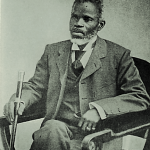

George Alfred Grant
-
- January 20, 2025

Born at Beyin to Madam Biawi and Mr William M Grant, in the Western Region of Ghana on the 15th of August 1878, George Alfred Grant was popularly known as Paa Grant. His family were prominent business people. He was the grandson of a Scotsman, one of the early merchant princes of the Gold Coast who was a member of the Legislative Council from 1863 to 1873. He started school at the Methodist Church School in Cape Coast and in 1895, moved to Axim a town known for timber trading. In Axim he worked as a messenger for a company called Messrs C.W. Alexander and Company who were dealers in timber as well as general merchants in Assini, Ivory Coast. He did so well that he was encouraged by the owners to start his own business and at 25, he opened his own commercial wood trading business and went to England to build business connections that resulted in offices in England and the United States of America. Eventually he owned shipping vessels and was a well-known figure in the timber business. It is reported that a single export could earn him $100,000. His trading firm George Grant and Company opened offices in Hamburg, Liverpool and other parts of Europe.
His granddaughter describes him as follows: “Papa was no big desk executive. Here was a man who spent much time in Dunkwa, Sefwi-Wiawso and other deep forest locations with his best friends during long days at work, and in the evenings play on the draughts board. These were the labourers with whom he felt most comfortable.”
He could see firsthand the unfairness towards local businesses and the indigenous workers and this pushed him into getting involved in politics and the call for independence from British colonial rule. He contributed funds for the organisation of the return of Kwame Nkrumah as the new Secretary General of the UGCC. His business indeed suffered for this involvement in politics and his timber was banned from being loaded onto trains and eventually banned from being boarded on ships at the harbour. RT Briscoe arrived from South Africa to understudy George Grant who took him round. Eventually when a law was passed preventing the exportation of round timber, the two entrepreneurs opened their own sawmills. Grant built his in Kojokrom and Briscoe in Essikadu, Sekondi. Whilst Briscoe’s application for power to run his mill was approved, Grant’s application was delayed. This made him turn to the use of gas to run his sawmill. His granddaughter wrote in the memory of her ancestor on the 61st anniversary of his death October the following words:
“On this 61st anniversary of his death on October 30, 1956, it is salutary to consider the evidence that in the deep pre-independence era, we had such noble persons fighting not only for freedoms but also for the fair treatment of the country’s local content in business. It bears repeating that the vestiges of these elements of colonial rule, continue to be the bane of many a local entrepreneur in our modern-day business world. It is to be lamented, for example, that it took the discovery of oil in commercial quantities in 2007 for Ghana to pursue a local content law that would cast this policy in stone.” -Phyliss Christian
Reference: Legend Ghana, Stephen Opoku Tontoh ISBN 978-9988-1-3522-5, Wikipedia and Phyliss Christian
